
Dramatica Narrative Theory

The Four Throughlines of a Grand Argument Story

by Katharine Elizabeth Monahan Huntley

There is a dearth of stories that fulfill us both intellectually and emotionally.  Inherent to stories that do engage an audience are sound structure and dynamic storytelling.  Dramatica, a relatively new narrative theory, expands upon current understanding of how engaging stories work.

Formulated apart from major theoretical paradigms, the Dramatica theory may prove compelling for its potential use in story creation and analysis (screenplays, teleplays, novels, short stories, and stage plays).

Created by writer/director Melanie Anne Phillips and film and television production software developer Chris Huntley, Dramatica offers a powerful solution to the problems of faulty stories and the absence of an accessible “reasoned account of the structure of the narrative, the elements of storytelling, their combination and articulation” (Chatman 15).  Dramatica addresses all components of a story, from the underlying deep structure to an audience’s reception of its meaning.

As an exposition of the entire theory is beyond the scope of this article, the focus is confined to one basic aspect of the Dramatica theory’s foundation—the four throughlines of a grand argument story.

Grand Argument Story

The grand argument story is a specific type of work that is conceptually complete and emotionally and logically comprehensive.  Qualities that substantiate a grand argument appear in the story’s structure (the underlying relationships between the parts of a story), dynamics (the moving, growing, or changing parts of a story), and the manner in which the grand argument is relayed through character, plot, theme, and genre.

In a grand argument story the author investigates all significant approaches to resolving the story’s specific problem, and provides the most appropriate solution to solve it.  Characters, plot, theme, and genre are the different families of considerations intrinsic to the grand argument story.  Characters enact the motivations.  Plot documents the problem-solving methods.  Theme examines values and their standards of measure.  Finally, genre establishes the overall attitude that influences the characters, plot, and theme.  By placing different emphases on character, plot, theme, and genre in the storytelling, the author communicates a certain message.

Four Throughlines

As in structuralism, Phillips and Huntley perceive a literary work as a construct “whose mechanisms could be classified and analysed like the object of any other science” (Eagleton 106).  According to Chatman, the basis of structuralism is “that each narrative has two parts: a story (historie), the content or chain of events (actions, happenings), plus what may be called the existents (characters, items of setting); and a discourse (discours), that is, the expression, the means by which the content is communicated” (19-20).  Chatman identifies the narrative’s “point of view” in the discourse, and further defines it as “the physical place or ideological situation or practical life-orientation to which narrative events stand in relation. . . . the perspective in terms of which the expression is made.  The perspective and the expression need not be lodged in the same person” (153).

Phillips and Huntley concur; they declare further that in Dramatica there are four different kinds of points of view, called the four throughlines, that probe the issues presented over the course of the story.  The significance of the four throughlines is they grant the opportunity for an audience to participate in the four points of view that comprise a grand argument. 

Dramatica’s four throughlines are the overall story throughline, main character throughline, impact character throughline, and main vs. impact character story throughline.  The overall story and main character throughlines are storytelling conventions comparable to the omniscient and first person points of view; the impact character and main vs. impact character story throughlines delve into two additional points of view.

The overall story throughline is the story’s objective, dispassionate viewpoint.  It contains the action and events in which all the characters take part.  An objective character is defined as a specific collection of dramatic characteristics that remain consistent throughout the overall story.  Objective story characters may be archetypal, e.g., the classic protagonist and antagonist, or complex.  Similar to “dramatis personae” (Propp 20), the simple arrangement of archetypal characters represents all the requisite functions of a complete grand argument story.  Although archetypal characters may conflict with one another, this type of character does not experience conflict within itself.  Archetypal characters may provide a form of storytelling shorthand.  This is convenient for an author who wishes to emphasize plot or theme, or is limited in storytelling time and/or space.  If not used for a clear purpose, however, a structurally simple character may not hold an audience’s interest.  Nevertheless, a comprehension of archetypal characters informs and enhances one’s appreciation for complex characters.  Complex characters more closely represent a real person because their internal elements can be at odds with one another.

The Dramatica conception of archetypal and complex characters can be compared to E. M. Forster’s discrimination between “flat” and “round” characters:

“A flat character . . . is built around “a single idea or

quality” and is presented without much individualizing detail,

and therefore can be fairly adequately described in a single

phrase or sentence.  A round character is complex in temperament

and motivation and is represented with subtle particularity;

such a character therefore is as difficult to describe with any

adequacy as a person in real life, and like real persons, is

capable of surprising us (qtd. in Abrams 24).”

The main character is the character to whom the audience emotionally relates; the heart of the story is what is explored in the main character’s throughline.  The main character may additionally fulfill the protagonist function in the objective story, for example, Catherine Sloper in Henry James’ Washington Square.  As the main character Catherine is the emotional focus; the reader empathizes with Catherine’s personal issues.  As the protagonist she is the prime mover of objective story’s action, the effort to make a suitable marriage.

An example of a main character that is not the protagonist is Scout in Harper Lee’s To Kill a Mockingbird.  The protagonist is instead her father, Atticus Finch.  Atticus is defending a black man unjustly accused of rape; the entire town is involved in the story of his trial.  The audience, however, is emotionally connected to Scout’s main character throughline as she attempts to understand prejudice and face her own preconceptions, particularly those of neighborhood bogeyman, Boo Radley.

The impact character, wittingly or unwittingly, has the most influence on the main character.  Unlike the antagonist who is directly attempting to stop the protagonist, e.g., Bob Ewell in To Kill a Mockingbird, the impact character throughline offers an alternative approach to the main character’s.  The impact character compels the main character to change or remain steadfast to their essential nature.  In To Kill a Mockingbird, main character Scout’s impact character is Boo Radley, the character who ultimately obliges Scout to face her personal bias.

The story’s passionate exchange is articulated in the main vs. impact character story.  The main vs. impact character story throughline examines what happens between the main and impact characters, fastening attention on the pressure that intensifies within the relationship until one ultimately defers to the other’s way of thinking.

A grand argument story is limited to stories balanced by the four throughlines.  As a storytelling choice, however, an author may emphasize one or more throughlines over the other(s) to great effect.  For example, the superb film Hilary and Jackie, adapted by Frank Cottrell Boyce and directed by Anand Tucker, centers on the main vs. impact character story relationship between two sisters, almost to the exclusion of the objective point of view, and to a lesser extent, the main and impact character points of view.  An example of when only one point of view is problematic can be found in Bret Easton Ellis’ controversial novel American Psycho.  The story imparts only the main character’s point of view; a larger context from which to derive meaning is absent.

Taken together, the four throughlines comprise the author’s argument to the audience.  Whether or not the audience is in agreement depends upon the individual, however, as long as the argument is made completely and consistently, it cannot be dismissed on its own terms.

Conclusion

Dramatica is valuable to an author’s story where lack of structure is problematic.  For original story creation, applying the fundamental concept of the four throughlines to a story aids in constructing sound structure, the foundation from which to build dynamic storytelling.  For the purpose of analysis, this allows insight vital to understanding author’s intent.  For the audience members, they can simultaneously experience all four points of view necessary for a Dramatica grand argument—an event that conveys a familiar context within which to find individual meaning in their own off-screen lives.

Works Cited

Abrams, M. H.  A Glossary of Literary Terms.  6th ed. Orlando: Harcourt, 1993.

Chatman, Seymour.  Story and Discourse: Narrative Structure in Fiction and Film.  Ithaca: Cornell UP, 1978.

Eagleton, Terry.  Literary Theory: An Introduction.  Minneapolis: U of MN P, 1983.

Ellis, Bret Easton.  American Psycho.  New York: Vintage, 1991.

Hilary and Jackie.  Dir. Anand Tucker.  Screenwriter Frank Cottrell Boyce,  1998.

James, Henry.  Washington Square.  Oxford: Oxford UP, 1982. (Washington Square first published in 1880)

Lee, H.   To Kill a Mockingbird.  London: Mandarin, 1960.

Phillips, Melanie A., and Chris Huntley.  Dramatica: A New Theory of Story. 3rd ed. Burbank: Screenplay Systems, 1996.

Propp, Vladimir.  Morphology of the Folktale.  Ed. Louis A. Wagner.  2nd. ed. Austin: U of Texas P, 1968.
Olympian Feat: Without Limits Dramatica Story Analysis

by Katharine Elizabeth Monahan Huntley

Steve Prefontaine has none of the usual insecurities. A track star in high school, he is courted by top colleges — the only one he wishes to attend, however, is the University of Oregon. Before he enrolls, Pre wants Bill Bowerman (impact character), a coach (impact character concern — being) who doesn’t believe in the value (impact character critical flaw) of himself recruiting, to invite him. Pre’s confidence (main vs. impact character catalyst) in his skill (unique ability) as a runner accelerates the relationship between Bill Bowerman and himself:

PRE: (to Bowerman’s assistant coach, Dellinger): I’ve got three weeks to sign my letter of intent before I’m gonna lose my slot at any college worth going to (main character signpost 1 — obtaining). Here’s my philosophy — I don’t go anywhere near Eugene unless Bowerman personally lets me know he wants me (main vs. impact character thematic conflict — value vs. worth).

EXT PHONE BOOTH

DELLINGER: Bill, for God’s sake! Everybody in the country’s been offering him the moon. All he wants is one word from you, to know that you want to coach him (impact character unique ability — ability).

Bowerman considers (main vs. impact character signpost 1 — conscious) Dellinger’s advice and writes to Pre: “If you do us the honor of attending the University of Oregon (story driver — action), there is no doubt in my mind that you can become (overall story precondition) the nation’s finest distance runner, perhaps the world’s” (overall story benchmark — future).

The overall story domain is explored in the confines of amateur track and field competition (situation) where athletes are ranked individually and in teams, whether for college or country. The goal centers on Steve Prefontaine’s progress as a college distance runner. To make his development meaningful, a requirement of the future is put in place (The Olympic Games) — Pre’s basic competitive drive (subconscious) is the prerequisite, and his insistence on becoming part of Oregon’s team an unessential restriction placed on the effort to achieve the goal.

In the overall story, proven (overall story problem) records drive the athletes to break them; in the impact character throughline, Bowerman’s proven (impact character problem) method of coaching is what Pre challenges (main character approach — doer):

BOWERMAN: Your pulse is north of 190 — just a rough guess (main vs. character focus — accurate) but I’d say you were exceeding the agreed-upon (impact character problem — proven) speed limit.

Pre’s natural instinct (main vs. impact character concern — preconscious) as a frontrunner leads to a contentious relationship with Bowerman — but his (in)experience (main character thematic issue), particularly in international competition, necessitates Bowerman’s ability (impact character unique ability) as a coach.

Pre is driven by the expectations (main character problem) he places upon himself. He arrogantly refuses to acknowledge any innate talent — he believes it is only by sheer guts (main character solution — determination) that he crosses the finish line first. The epitome of poetry in motion, Pre died instantly in an auto accident the evening of winning the American 5000 meter. In his eulogy, Bill Bowerman illuminates how the coach who went on to create Nike shoes and his “showboat” runner who embodied the phrase “Just do it” make Without Limits a success story (outcome), despite Steve Prefontaine’s tragic end.

BOWERMAN: All my life, man and boy, I’ve operated under the assumption that the main idea in running was to win the race (impact character domain — manner of thinking). Naturally, when I became a coach I tried to teach people how to do that. Tried to teach Pre how to do that. Tried like hell to teach Pre to do that. And Pre taught me. Taught me I was wrong.

Pre, you see, was troubled by knowing (main character critical flaw — fact) that a mediocre effort can win a race and a magnificent effort can lose one. Winning a race wouldn’t necessarily demand that he give it everything he had from start to finish. He never ran any other way (main character resolve — steadfast). I couldn’t get him to, and God knows I tried . . . but . . . Pre was stubborn (main character vs. impact character domain — fixed attitude). He insisted (main character solution — determination) on holding himself to a higher standard than victory (main character judgment — good). ‘A race is a work of art’ (main character concern — doing) is what he said and what he believed and he was out to make it one every step of the way (problem solving style — logical).

Of course he wanted to win. Those who saw Pre compete (main character domain — activity) or who competed against him were never in doubt how much he wanted to win. But how he won mattered to him more (main vs. impact character solution — process). Pre thought I was a hard case. But he finally got it through my head (impact character resolve — change) that the real purpose of running isn’t to win a race (main vs. impact character problem — result). It’s to test to the limits of the human heart. That he did . . . No one did it more often. No one did it better.

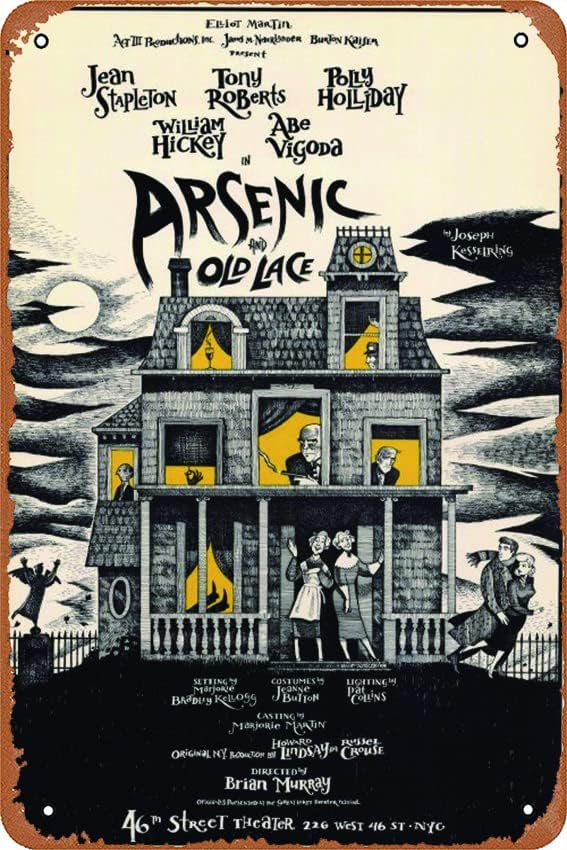
Arsenic and Old Lace: Dramatica Story Analysis

by Katharine Elizabeth Monahan Huntley

Frank Capra’s Arsenic and Old Lace “. . . is a Halloween tale of Brooklyn, where anything can happen and it usually does.” Mortimer Brewster, dramatic critic and main character, finds himself in the situation (mc domain-universe) of “The guy who wrote the bachelor’s bible finally getting hooked himself.” Standing in line to obtain (relationship story concern) his and his intended’s (Elaine Harper, the influence character) marriage license, he attempts to avoid (mc solution) publicity by whispering: “I don’t want this to get out for a while” to the court clerk (mc thematic issue of delay), and dodging photographers by wearing dark “cheaters” and ducking (mc approach-doer) into a telephone booth.

Exasperated by the problems this endeavor (rs domain-physics) has created, Mortimer sounds off to Elaine: “Don’t you understand (rs signpost 1)? How could I marry you? Me, the symbol of bachelorhood! (rs thematic issue of self interest) I’ve sneered at every love scene in every play! I’ve written four million words against marriage! Now I’ll be hooked to a minister’s daughter (rs thematic counterpoint-morality)! . . . I won’t go through with it and that’s that (rs inhibitor-commitment)!” Elaine, dewy-eyed faithfulness (rs response), patiently waits out his tirade and they go on to get hitched.

The newlyweds taxi over to the Brewster sisters’ house. Elaine is the proverbial girl next door, having grown up in the parsonage next to Mortimer’s maiden aunts (“they’re like pressed rose leaves”). The young couple’s intention is to announce the marriage to their respective relatives, then set off for a honeymoon in Niagara Falls. Meanwhile, the aunts and Reverend Harper are taking tea, discussing Mortimer and Elaine’s relationship. Reverend Harper voices his disapproval of Mortimer’s book, Marriage: A Fraud and a Failure: “No man with this published attitude on marriage should take any man’s daughter any place, anytime.” (mc symptom-oppose)

Reverend Harper departs. Mortimer enters and reveals his newlywed status to Aunt Abby and Aunt Martha. They are thrilled, as this is what they had hoped (ic thematic issue) for Elaine and their nephew all along. When Mortimer asks for the hidden notes on his forthcoming novel, Mind over Marriage, the critic’s concern for his future indicates conflict between private and public persona—yes he may be a married man, at least on paper, but in the eyes of the public he is the quintessential bachelor. In the search, Mortimer discovers a dead body in the window seat (story driver-action). Further, his aunts are the ones responsible (os catalyst) for killing him and a dozen or so others with kindness in the form of arsenic in elderberry wine. From this point on the objective story is emphasized, particularly in the storytelling, to the near exclusion of the main character, influence character, and relationship story throughlines.

The objective story domain is psychology, and the characters’ different ways of thinking are what causes problems. “Charge” is the battle cry of Mortimer’s brother, believing himself to be Teddy Roosevelt. Long lost other brother Jonathan is a psychopath with a cold body of his own and no qualms about rubbing out immediate family. Aunt Abby and Aunt Martha’s pursuit (os problem) of lonely old gentlemen to poison (“Murder Incorporated”), thinking it the charitable thing to do, is a dilemma—Mortimer scolds: “I don’t know how I can explain this to you, but it’s not only against the law, it’s wrong! It’s not a nice thing to do! People wouldn’t understand. . . . this is developing into a very bad habit!”

The story goal of becoming is somewhat nebulous, however, becoming as an objective story concern is quite evident. Elaine becoming part of a wacky family: “You wouldn’t want to set up housekeeping in a padded cell . . . insanity runs in my family—it practically gallops!”—Jonathan becoming the “prodigal son”—his Boris Karloff countenance undergoing a physical transformation at the tremulous hands of Dr. Einstein–the burly cop on the beat becoming a playwright, and so forth. The thematic conflict of commitment vs. responsibility is also quite marked. O’Hara takes over Officer Brophy’s responsibilities for protecting the neighborhood, a nephew’s responsibilities to his family take precedence over the commitment to a new bride, much discussion is given to committing Teddy to Happydale.

“Egads!” Mortimer comes across a new body (Jonathan’s victim) in the window seat and demands an explanation from Aunt Abby. She’s outraged: “It’s a stranger. . . . It’s getting so anybody thinks he can walk in this house . . . That man’s an impostor! And if he came here to be buried in our cellar he’s mistaken!” Mortimer is exasperated: “Aunt Abby how can I believe you!” (os symptom-disbelief) He feels he must prevent (os solution) his aunts from becoming Sing Sing inmates for their well-intentioned misdeeds. He takes the necessary steps (mc mental sex-male) to commit Teddy sooner than originally planned. Mortimer’s thinking is, if anyone becomes wise to the bodies buried down in Panama (the cellar), Teddy can take the rap “. . . everybody knows he’s crazy.”

The nocturnal activities of Jonathan and his henchman, weaselly Dr. Einstein, skulking about with their body (Mr. Spinoza), and the aunt’s fussy preparations to hold funeral services for their murder victim (Mr. Hoskins), not to mention a near hysteric Elaine running in and out of the household (ic benchmark of preconscious) alerts Officer O’Hara. He stops in—but instead of clueing into how things are going (forewarning of progress), he pitches his play to Mortimer (os inhibitor of self-interest). Madness, mayhem, double takes and pratfalls continue until Teddy’s blasted bugle brings in Lieutenant Rooney.

Temporary sanity sorts out the confusion—Jonathan is carted off by New York’s finest—Mr. Witherspoon packs up Teddy’s duffel for Happydale (after pitching his play to the dramatic critic)—Aunt Abby and Aunt Martha avoid the slammer by committing themselves as well, but not before letting Mortimer in on a family secret. He is not really a Brewster, but the “son of sea cook”—a happy fact he shouts to the world as he kisses his wife for all to see (mc resolve-change) and starts (mc growth) his happily ever after (outcome-success; story judgment-good).

Postscript: I once spotted Abe Vigoda “Fish” at Diablo Valley College “The Rock.” His nephew was in a school play.