
by Kerrin Ross Monahan
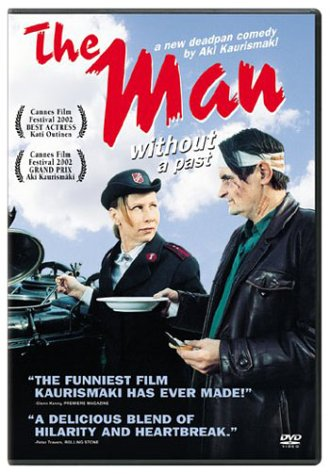
The Man Without a Past, written and directed by Aki Kaurismäki is the second part of his “Finland” trilogy. This writer/director’s films are all very short and ” . . . eccentric parodies of various genres . . . set to eclectic soundtracks, typically based around 50s rock ‘n’ roll.” — Unknown. He has been quoted as saying, “Life is too hard to bear and there is no hope for anyone.” He concentrates on that segment of Finnish society he calls “the hidden people”: the outcasts and the homeless and those who simply don’t fit in, by any society’s standards. This director is “glum, but optimistic” which is quite apparent, at least in this particular film.
Kaurismäki is known to have no rehearsals. Actors do one run-through and then they’re captured on film for good or ill. Their dialogue is spare, dry, and to the point. (When one is living hand to mouth, there are no soliloquies). In The Man Without a Past, this certainly works advantageously, because the audience is caught up in the immediacy of the moment — in the raw here and now.
Kaurismäki’s titular character is beaten so badly by street thugs that he loses his memory completely. Fortunately, he is befriended by other so-called street people — a family who lives in an abandoned sea freight container. There are other characters who also give whatever little of themselves they have left. The Salvation Army plays a prominent part and, in a very funny scene, change the tenor of their “gig” to great advantage.
The movie does indeed have many life-embracing moments; the director is never maudlin, and he allows light, even sidesplitting bits to show through. Or rather, the actors do (upon whom this director purposely puts the responsibility for most of the directing: after all, we all are for the most part responsible for the direction of our own individual lives, or at least most of us should be). The “establishment” is shown in its full, arrogant, “take no prisoners” mode, but in such a way the audience almost (but not quite) feels a modicum of pity.
All in all, a fresh, positive, feel without any “Pollyanna” takes. The “man” in a way is lucky — he doesn’t have the baggage of his past weighing him down, and because of this, he triumphs on his own terms.