by Katharine Elizabeth Monahan Huntley

Harvard Westlake Plays!
Tech Glenn With The Extra N!
Good Golly, Molly!

Fig. It. Out.
by Katharine Elizabeth Monahan Huntley
Harvard Westlake Plays!
Tech Glenn With The Extra N!
Good Golly, Molly!
by Katharine Elizabeth Monahan Huntley

Diaphanous Doll.
Roller Skating Down The Hall.
Princess. Diana.
by Katharine Elizabeth Monahan Huntley

Malibu Barbie.
Jane Pratt says Pam, Honestly.
Stay Gold No Frills Girl.
by Kerrin Ross Monahan
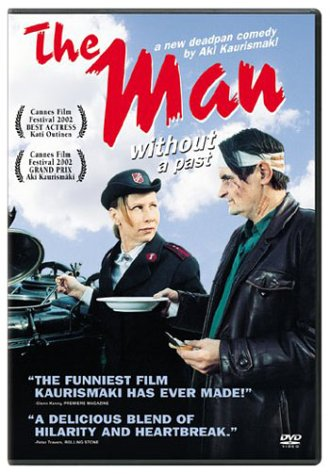
The Man Without a Past, written and directed by Aki Kaurismäki is the second part of his “Finland” trilogy. This writer/director’s films are all very short and ” . . . eccentric parodies of various genres . . . set to eclectic soundtracks, typically based around 50s rock ‘n’ roll.” — Unknown. He has been quoted as saying, “Life is too hard to bear and there is no hope for anyone.” He concentrates on that segment of Finnish society he calls “the hidden people”: the outcasts and the homeless and those who simply don’t fit in, by any society’s standards. This director is “glum, but optimistic” which is quite apparent, at least in this particular film.
Kaurismäki is known to have no rehearsals. Actors do one run-through and then they’re captured on film for good or ill. Their dialogue is spare, dry, and to the point. (When one is living hand to mouth, there are no soliloquies). In The Man Without a Past, this certainly works advantageously, because the audience is caught up in the immediacy of the moment — in the raw here and now.
Kaurismäki’s titular character is beaten so badly by street thugs that he loses his memory completely. Fortunately, he is befriended by other so-called street people — a family who lives in an abandoned sea freight container. There are other characters who also give whatever little of themselves they have left. The Salvation Army plays a prominent part and, in a very funny scene, change the tenor of their “gig” to great advantage.
The movie does indeed have many life-embracing moments; the director is never maudlin, and he allows light, even sidesplitting bits to show through. Or rather, the actors do (upon whom this director purposely puts the responsibility for most of the directing: after all, we all are for the most part responsible for the direction of our own individual lives, or at least most of us should be). The “establishment” is shown in its full, arrogant, “take no prisoners” mode, but in such a way the audience almost (but not quite) feels a modicum of pity.
All in all, a fresh, positive, feel without any “Pollyanna” takes. The “man” in a way is lucky — he doesn’t have the baggage of his past weighing him down, and because of this, he triumphs on his own terms.
by Kerrin Ross Monahan
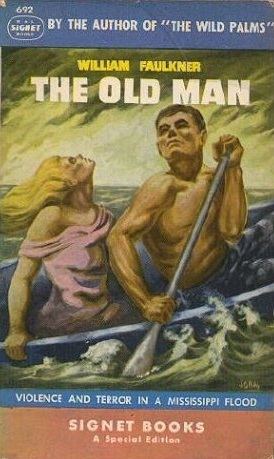
| In William Faulkner’s short fiction, The Old Man and The Bear, the author uses a convict and a bear as protagonists of their respective stories. In a strange way, the tall convict and the animal both represent the same thing. They each stand for a certain purity, and innate innocence, in the face of an increasingly evil and disintegrating society. It is clear Faulkner feels the world encroaching upon the bear, and the world outside prison walls—is civilization at its worst, or at least a culture rapidly becoming that way. The Old Man stands for the Mississippi River, a symbol of life itself with all its vicissitudes and unforeseen mishaps and tragedies. Restless, unpredictable, and powerful, it can obliterate and sweep away everything in its path. The story takes place in Mississippi, 1927. The tall convict, an unschooled rural type, is serving a fifteen-year jail term for attempted train robbery. The staff volunteers certain inmates to help in an emergency rescue operation brought on by a flood; thus Faulkner puts his character back in the midst of the same civilization he felt had misused the young man. It should be noted that the Deep South has traditionally had a far more conservative and repressive penal code than possibly anywhere else in the United States. Faulkner immediately depicts what he felt were societal faults. We hear the story of the short and plump convict who was given an outrageous sentence of one hundred and ninety-nine years—for a murder he didn’t commit. In very strong terms, the author asserts those acting on behalf of the law were: “blind instruments not of equity but of all human outrage and vengeance, acting in savage personal concert . . . which certainly abrogated justice and possibly even law.” In the end, the tall convict (with eight years left on his sentence) is given an additional ten because, when he hadn’t immediately returned from his rescue assignment, he had been officially declared dead on paper, and the prison officials wouldn’t change anything for fear of making themselves not only look foolish, but also for fear of political repercussions. Faulkner not only attacks the iniquities of the legal processes, but racial prejudice as well. One white evacuee is indignant at the fact the rescue launch is too full to take him: “. . . no room for me . . .”Another symbol of the society that had let the tall convict down was the pregnant woman he had rescued from the waters. He had spent weeks taking care of her amidst the most perilous of conditions, but the reader never sees or hears her thank him in any way whatsoever. His teenage girlfriend that he describes in the very end, quite possibly the cause of his attempted robbery, had only visited him once in jail and then sent a postcard announcing her marriage. His last words: “Women, _ _ _t” sums up the betrayal he felt toward the opposite sex. It is then no wonder that the tall convict views life behind bars as a “comparatively safe world.” He saw the outside world as a “separate demanding threatening inert yet living mass of which both he and she (the pregnant woman) were equally victims.” Prison to him was “home, the place where he had lived almost since childhood, his friends of years . . . the familiar fields . . . the mules . . . barracks [with] good stoves in winter . . . food . . . Sunday ball games and the picture shows.” All of this certainly does evoke a comforting and homelike atmosphere. Even though, near the end of his adventure, he realizes he had “forgot how good it is to work” and make money, after he was safely back in the barracks he felt that he was then secure from the “waste and desolation” the Old Man represented. It is as if everything had been reversed: the real world, comforting and familiar was in jail, and the life outside was confusing and frightening. Because the convict had accepted his lot in life and possessed a strong feeling of duty, he is, in a certain way, free. The Bear spans approximately eleven years, from 1877 to 1888, when Ike, the young boy, grows from age ten to twenty-one. In the beginning, Faulkner sees the bear, Ben, as free, a formidable legend of the forest. He invests the animal with wisdom and dignity and there is a worthy, although adversarial respect between him and Ike. Faulkner gives us his own feeling in the very first paragraph: “. . . only Sam Fathers, Ike’s mentor, and Old Ben and the mongrel Lion were taintless and incorruptible.” He speaks of the natural landscape as “that doomed wilderness where edges were being constantly . . . gnawed at by men . . .”Sam’s father was the son of a Negro slave and a Chickasaw chief and it is he more than anyone else who teaches Ike to have respect, almost a great reverence, for nature. Certainly, he is anxious to track down Ben, but when he had the chance, he didn’t kill him, because, as Ike said: ” . . . it (the killing) won’t be until the last day, whenever he don’t want it to last any longer.” When the hunter Boon and the dog Lion finally kill the bear, Old Sam “collapses because he knows this is the “last day,” the end of an era, not just of his own life, but also of the pristine wilderness. Sam had successfully passed on his reverence for life to Ike and it is he who makes a primitive pyre for Sam and the dead dog. Faulkner uses racial prejudice in this story as well, to show what he thinks of the world. At first, Part Four seems out of place, a complicated genealogy in the form of a family diary. These records show there is African American blood back in the family history. Through this device the author exposes the exploitation and mistreatment of the American Natives and Black slaves by the Whites. The author then states that man should: “Hold the earth mutual and intact in the communal anonymity of brotherhood . . .”In the end, progress invades in the form of the lumber company. Major de Spain, one of the original hunters, had sold out and a new planing mill is built. The log train, that had once simply been an unobtrusive way in and out of the forest for hunters, now had become something more menacing: “It was a doomed wilderness. . . . The shadow and portent of the new mill . . .” Ike himself, now twenty-one, at this moment knows he will never return to the old hunting site again. Faulkner then invokes the “trinity” of Sam and Ben and Lion, a kind of resurrection: “There was no death, not Lion and Sam . . . and old Ben too . . . not held fast in earth but free in earth and not in earth but of earth . . .” In dying, this trio took with them the last of the old revered way of life that can only be born again in the hearts and minds of human beings. Faulkner’s view of the worlds in which these two stories take place is rather dim and negative. Society, in the name of progress, is destroying, unchecked, a pure and innocent world. The tall convict instinctively and ironically retreats back to the safety of man-made bars in the face of nature gone amok. The bear, with a similar kind of instinct, deliberately lets himself be caught and killed; death being a safe retreat from man gone amok. Neither story holds out much hope for the future and it is clear that Faulkner had little faith in society’s ability to foretell and correct these cultural ills. Work Cited Faulkner, William. Three Famous Short Novels: Spotted Horses, Old Man, The Bear. New York: Vintage, 1961. |
by Kerrin Ross Monahan
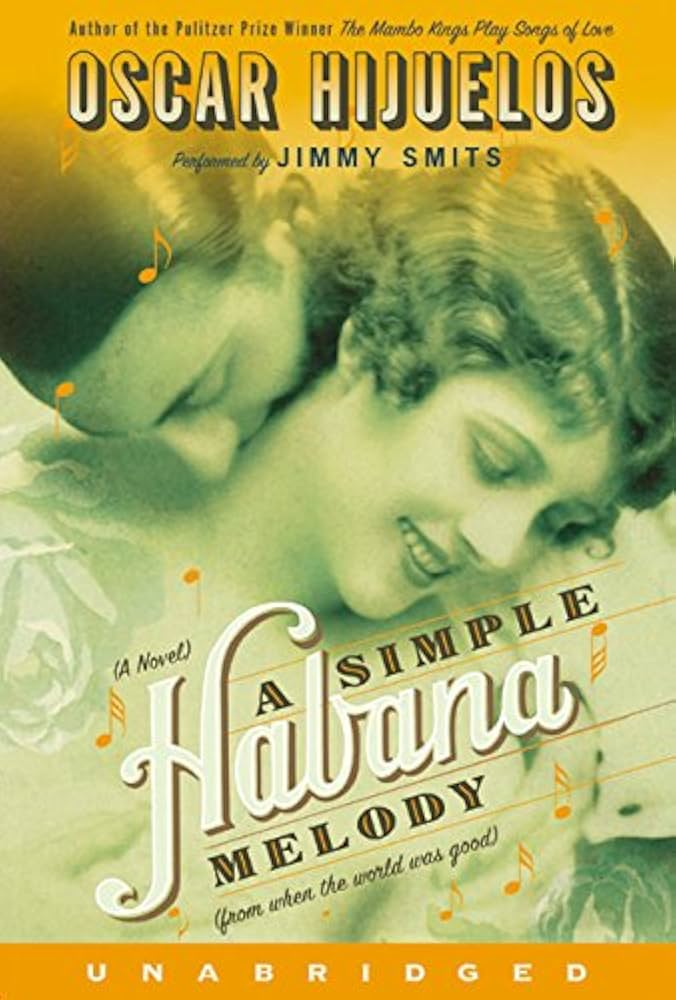
Oscar Hijuelos’ (Pulitzer prize-winning author of The Mambo Kings Play Songs of Love), A Simple Habana Melody is a nostalgic, lavish, and lush story about art, politics, religion, culture, family, war, and history; about different kinds of sex and sexuality; about women: (a broad spectrum ranging from the Virgin herself to all types of “putas”). But above all it is about music, music, music — especially what the music represents.
The book is anything but “a simple melody.” On the contrary, it is a very complicated, complex, and profound oratorio on life itself as seen through the eyes of an extraordinary man: “. . . my own protagonist . . . whose dreams are the dreams of those who the wish the world well.” (Author’s note.)
Israel Levis, Cuban composer, experiences life fully through the five senses. The reader can taste the wonderful food and drink (of which there are copious amounts), smell the aroma of the tropical flowers and the richness of Cuban coffees and cigars, feel the warm, soft sea breezes, see the bright floral colors and the sun’s rays glittering on the Caribbean sea. Most of all, the reader hears the music — the notes seem to flow off the pages — swaying shades and nuances and tones that never let go; instead they continue to haunt Levis and the reader, especially Rosas Puras (Pure Roses, and as the author also interprets: Pretty Roses.) This is Levis’ most famous song, played the world over, which he hurriedly wrote at the request of his undeclared love, Rita Valladares:”Rosas Puras. I had a melody that came instantly to me, arranged with the assistance of that unseen and underappreciated inspiration which can only come from God.” Thus, the composer identifies his most popular and enduring song with Rita, the love of his life.
So here we get to the essence of the story, which is love with all of its complicated facets. Love of country, of art, politics, religion, culture, family, and humanity itself. Overreaching it all, love for Rita: countless opportunities for Levis to connect deeply with that one other soul for whom he has had a lifelong yearning. Opportunities that he let slip by. Rather, he uses “memory as companion,” his diffidence and quiet reserve always and ever prohibiting him from declaring himself to his beautiful and flamboyant young protégé. (Perhaps he should have taken his lyricist friend Manny’s advice: “Live as if no one else matters.”)
The sad part is that Rita never was able to declare her love to him, either. Rather, she ran through four husbands (he never married), and died with “his name . . . never . . . far from her lips . . . crying with tender thoughts about him.”
“The purest rose will always last, like the love in our hearts.” To Israel and Rita, a simple Habana melody represented the deep and complex unrequited love that they had always carried for each other.
Not so simple after all.
by KE Monahan Huntley

Percussion rushin’.
Long Lines at the House Parties.
Blare. Glare. Stop and Stare.